Key Takeaways
- A bilingual AI receptionist answers calls in English and Spanish 24/7 and switches languages mid-call.
- About two in three Miami-Dade residents speak Spanish at home, so English-only lines lose real customers.
- Callers simply talk to the AI, with no “press 2 for Spanish” menus to get stuck in.
- Medical, legal, home services, real estate, and hospitality businesses see the fastest payoff.
- The best results come from a hybrid model where AI handles routine calls and people handle complex ones.
- Connect the AI to your calendar, CRM, phone system, and Microsoft Teams so nothing gets copied by hand.
- Florida requires all-party consent to record calls, so disclose recording in both languages up front.
- Start with an after-hours pilot, review every transcript, and expand once the AI sounds right.
A bilingual AI receptionist answers your business phone in English and Spanish at any hour, and it switches languages the moment a caller does. For South Florida businesses, that one feature often decides whether a call becomes a booked appointment or a hang-up.
Most owners in Miami-Dade will recognize this scene. It’s 6:40 p.m. and a homeowner in Hialeah has water coming through her kitchen ceiling. She calls three plumbers. The first goes to voicemail. The second answers in English only, and she struggles to describe the leak. The third picks up with a friendly “Thank you for calling, ¿prefiere español?” and books a technician for 7:30.
Guess who gets the job.
That third company didn’t hire a night-shift bilingual receptionist. It used an AI call answering service that works in both languages without breaks, sick days, or overtime. Below, you’ll see how the technology works, which local industries gain the most, what it costs, and how to set it up without tearing apart the phone setup you already have.
What Is a Bilingual AI Receptionist?
A bilingual AI receptionist is a voice agent that answers inbound calls, understands natural speech in two languages (usually English and Spanish), and handles tasks like booking appointments, answering common questions, taking messages, and transferring calls. It detects the caller’s language on its own and replies in kind.
That last part matters more than it sounds. The old approach was a phone menu: “For Spanish, press 2.” Then came more menus, often with stiff recorded translations, and plenty of callers gave up before reaching anyone. Our comparison of AI Agent vs IVR shows exactly where those menus lose people.
A modern AI receptionist skips the menu. The caller just talks. If they start in Spanish, switch to English to spell an email address, then drift back to Spanish, the agent keeps up. In Miami, that kind of code-switching isn’t an edge case. It’s a normal Tuesday.
Why South Florida Businesses Need Bilingual Call Handling
Spanish isn’t a niche language here. In a lot of homes, it’s the default. About two in three Miami-Dade residents speak Spanish at home, and only about 24% speak English alone, based on a 2024 analysis of Census survey data. The county’s economic development group puts the Hispanic share at 69.1% of roughly 2.8 million residents.
Many of those residents are fully bilingual. Many aren’t. A 2018 Florida Senate bill, citing Census figures, counted more than 760,000 Spanish speakers in Miami-Dade who speak English less than “very well”. Broward and Palm Beach counties have large Spanish-speaking communities of their own, and Haitian Creole is common in North Miami, Little Haiti, and parts of Broward.
So what happens when one of those callers reaches an English-only line? Usually they hang up and dial the next company on Google Maps.
Your phone line is part of the fix. Businesses using modern VoIP Phone Services Florida can route calls to an AI receptionist quickly, keep their existing numbers, and add bilingual coverage to every location from Homestead to Jupiter. No new hardware and no rewiring the office.
What a Bilingual AI Call Actually Sounds Like
Take a call to a dental office in Kendall at 8:15 p.m., long after the front desk has gone home.
The AI greets the caller in both languages. The caller says, “Hola, necesito una cita para limpieza.” The agent answers in Spanish, asks whether she’s a new or returning patient, checks the calendar, and offers Thursday at 10 a.m. or Friday at 2 p.m. She picks Friday. The agent confirms her name, date of birth, phone number, and insurance, then texts a confirmation in Spanish.
Then she goes off script: “¿Hacen blanqueamiento?” The AI answers from the office’s approved FAQ, gives the starting price the owner signed off on, and adds a note for a whitening consult. The whole call takes under three minutes.
The next morning, the office manager reads a clean summary in English. Nobody on staff has to translate anything to follow up.
This works best when the AI sits inside your existing Business Phone Systems instead of on a separate number. You decide the rules: the AI can answer every call, only after hours, or only when staff lines are busy.
Which South Florida Industries Benefit Most
Any business that takes calls from the public can use one, but some see the payoff faster.
Medical and dental practices sit at the top. Patients call to book, reschedule, check insurance, and ask about refills, often in Spanish and often after hours. AI Voice Agents built for appointment scheduling can absorb most of that volume and pass anything clinical to staff.
Law firms in Miami and Fort Lauderdale handle immigration, personal injury, and family cases where the first call decides everything. Someone who can’t explain their situation in their own language rarely calls back. An AI intake agent gathers the basics and books the consultation.
Home services companies, including HVAC, plumbing, roofing, and pest control, live on answered calls. When an AC unit dies in Doral in August, the first company to pick up usually wins.
Property management and real estate offices field showing requests and maintenance tickets from tenants who may prefer Spanish or Portuguese.
Restaurants, hotels, and tour operators from Brickell to Key West hear from Latin American visitors around the clock. And tax preparers in Hialeah know what a 12-week rush feels like. Nobody wants to hire for a peak that short.
AI Receptionist vs Human Receptionist vs Answering Service
A bilingual AI receptionist won’t replace every person on your team, and it shouldn’t try. It fills the gaps: nights, weekends, lunch breaks, and those moments when four lines ring at once.
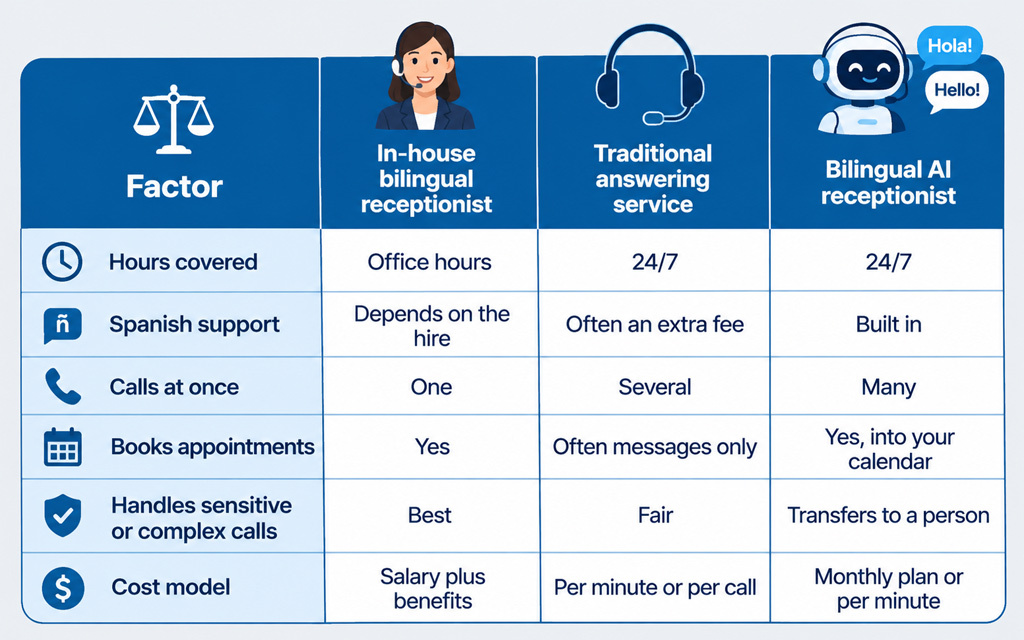
People still win on emotional calls, messy complaints, and longtime clients who expect a familiar voice. Answering services cover the hours but often just take messages. For the full trade-off, read our breakdown of AI Receptionist vs Human Answering Service.
Our view: most small and midsize businesses in South Florida do best with a hybrid. Let the AI take the first ring and the routine calls, then pass the tricky ones to a person who already has the full context.
How It Fits Into Your Communications Setup
An AI receptionist is only as useful as the systems it can reach. If it books an appointment but can’t write to your calendar, someone still copies it over by hand the next morning.
Look for a setup where the AI connects to your scheduling software, your CRM, and your phone platform. Then every call creates a record, every booking lands on the calendar, and every transfer reaches the right desk or cell phone. Businesses already running Unified Communications Solutions have an easier time here, because voice, messaging, and video already share one platform and one admin panel.
A simple test before you buy: ask the vendor to show a live call in Spanish going from greeting to booked appointment to CRM entry. If they can’t, keep looking.
Handing Calls to Your Team in Microsoft Teams
Plenty of South Florida offices now run their workday inside Microsoft Teams, especially firms with hybrid staff spread across Miami-Dade, Broward, and Palm Beach. When the AI needs a human, the cleanest handoff is a transfer straight into Teams with a short call summary already on screen.
Picture a paralegal working from home in Pembroke Pines. Her screen shows: Spanish-speaking caller, car accident yesterday, wants a consult, prefers mornings. She picks up already knowing the story, and the caller never hears “Can you repeat that?”
With proper Microsoft Teams Integration, calls, chats, and voicemail transcripts all land where your staff already works.
Turning Calls Into Video Consults
Some calls end with “Let’s set up a meeting.” A realtor books a virtual walkthrough of a Coral Gables condo for a buyer in Bogotá. An immigration attorney schedules a video consultation with a client’s relative in Caracas. The AI can text the meeting link in the caller’s language the second the booking is confirmed.
Pair it with Web & Video Collaboration tools, and the whole path from first ring to face-to-face meeting runs without anyone on staff touching it.
Handling the Paperwork That Follows a Call
Fax isn’t dead in South Florida. Medical offices, title companies, and law firms still get referrals, records, and signed forms by fax every week. When the AI tells a caller to fax over a referral, those pages shouldn’t sit in a tray by a machine nobody checks.
Fax to Email Communication Software drops incoming faxes into an inbox as PDFs. Staff can match each one to the call record the AI already created, so the referral and the appointment show up together.
Security, Privacy, and Compliance
Phone calls carry sensitive details: dates of birth, insurance IDs, case facts, sometimes card numbers. Ask hard questions before you switch anything on.
Where are recordings and transcripts stored, and for how long? Is data encrypted in transit and at rest? Will the vendor sign a Business Associate Agreement if you’re a HIPAA-covered practice? Can the greeting tell callers the call is recorded, in both languages? Florida requires the consent of everyone on a call before it’s recorded, so that disclosure belongs right up front.
The network underneath matters too. Weak SIP passwords and exposed admin portals are still a common way toll fraud starts. Following basic VoIP Security Best Practices, like strong credentials, multi-factor login for admins, and alerts for unusual call spikes, keeps your AI line from becoming someone else’s free international calling plan.
How to Set Up a Bilingual AI Receptionist
Most businesses can go live within a couple of weeks. This order tends to work well:
- Pull your call data. Look at the last 60 days. When do calls peak, how many go unanswered, and what share comes in Spanish?
- List your top 15 questions. Hours, price ranges, service area, insurance accepted, parking. Have a native Spanish speaker on your team review the Spanish answers.
- Pick the voice and greeting. Decide whether the AI opens in English, Spanish, or both.
- Connect your calendar and CRM. Test bookings end to end before a real caller ever hears the AI.
- Set transfer rules. Emergencies, upset callers, and anything the AI isn’t sure about go to a person.
- Pilot after hours first. Run nights and weekends for two weeks, read every transcript, fix what’s off, then expand.
If transfers will ring into Teams, follow a Guide to Microsoft Teams Integration so call queues, presence, and voicemail are ready before launch instead of patched later.
One tip that saves headaches: regional Spanish is real. Callers from Havana, Bogotá, and San Juan often use different words for the same thing. Have staff from different backgrounds test the agent before it goes live.
What Does a Bilingual AI Receptionist Cost?
Pricing varies by vendor. Most plans are monthly, based on call minutes or volume, with a setup fee for custom integrations. In most cases the total lands well below a full-time bilingual hire, and the AI covers all 168 hours of the week instead of 40.
The better question is what missed calls cost you today. Try this math: weekly missed calls, times the share that would have booked, times your average job value. A roofing company that misses 20 calls a week, would book a third of them, and averages $1,500 a job is leaving about $10,000 a week on the table. Recover even a slice of that and the AI pays for itself fast.
Watch for hidden costs, such as per-transfer fees, charging Spanish as an “add-on language,” and long contracts. Ask for month-to-month terms during your pilot.
Answer Every Caller in Their Language
South Florida runs on two languages, and your phone line should too. A bilingual AI receptionist picks up on the first ring, speaks the caller’s language, books the appointment, and brings in your team only when a person is really needed.
OmniCaaS helps businesses across Miami, Fort Lauderdale, and West Palm Beach set up AI receptionists on top of the phone and collaboration tools they already use. Book a demo, call it in Spanish, and hear the difference for yourself.

Post a Comment