
Key Takeaways
- Answers every scheduling call around the clock, including nights, weekends, and holidays when most practices have nobody at the desk.
- Cuts missed visits by handling reminder calls, confirmations, and same day rebooking without a staff member lifting a phone.
- Frees front desk teams from repetitive scheduling calls so they can focus on patients standing in front of them.
- Works across multiple lines at once, so a busy Monday morning doesn’t mean a busy signal for patients.
- Integrates with practice management and EHR systems to pull real time openings instead of guessing at availability.
- Speaks naturally in English and other languages, which matters for practices serving diverse patient populations.
A patient calls a family clinic at 6:45 in the evening. The front desk closed an hour ago. Under the old system, that call goes to voicemail, and there’s a real chance the patient books with a competitor instead, or simply skips the visit. This is the exact gap AI voice agents are built to close, and it’s why so many medical offices in Florida and across the United States are quietly replacing overworked phone trees with something that actually answers.
Scheduling is the front door of a medical practice, and right now that door is jammed for a lot of clinics. Staff juggle insurance calls, walk ins, refill requests, and a phone that never stops ringing, all while trying to keep a waiting room moving. Something has to give, and too often it’s the caller who gets put on hold, forgotten, or bounced to a message that never gets returned.
Quick answer: AI voice agents improve appointment scheduling by answering every call immediately, checking real time availability, confirming visits ahead of time, and rebooking cancellations before the slot goes to waste, all without adding staff.
What Are AI Voice Agents, and Why Do Medical Offices Need One?
An AI voice agent is a software based caller that can hold a real conversation over the phone, check a calendar, book or move an appointment, and confirm the details back to the patient, all without a human on the line. It isn’t the old press one for billing menu. It listens, understands context, and responds the way a trained scheduler would, just without needing a lunch break.
For healthcare specifically, the appeal is obvious once you look at the math. Industry research consistently shows medical practices lose a meaningful share of scheduled visits to missed appointments, and a separate chunk of calls get abandoned before anyone even reaches a live person, often because hold times run too long during peak hours. Every one of those is either lost revenue or a patient who didn’t get seen. A well configured voice agent addresses both problems from the same starting point: pick up the phone, every time, and handle the request correctly.
Practices searching for a fix often type some version of the same question into Google: how do I stop losing patients to missed calls. The honest answer is that most calls aren’t complicated. They’re a name, a reason for the visit, and a preferred day. A voice agent handles that combination reliably, which frees the humans on staff for the calls that actually need judgment.
How Do AI Voice Agents Improve Appointment Scheduling?
The mechanics are simpler than most people expect. The agent connects directly to the practice’s scheduling software, so when a patient calls to book a visit, it sees the same open slots a receptionist would see. It asks the right questions, confirms insurance type if needed, and locks in the appointment on the spot.
Reminder calls work the same way in reverse. Instead of a generic text that gets ignored, the agent calls a day or two ahead, confirms attendance, and offers to reschedule right there if the patient can’t make it. That single feature tends to do the most work against missed visits, because it catches the cancellation early enough to fill the slot with someone else.
There’s also the volume problem. A front desk with two staff members can realistically manage two calls at a time. An AI voice agent can hold dozens of simultaneous conversations, which matters enormously on a Monday morning when every patient who postponed calling over the weekend dials in at once.
Why This Matters More for Healthcare Practices in Florida and Beyond
Florida’s healthcare market skews older, seasonal, and spread across a lot of smaller clinics rather than a handful of giant hospital systems. That combination means call volume swings hard by season, and a lot of practices simply can’t staff for the busiest weeks without overpaying during the quiet ones. A voice agent scales automatically. It handles the January rush the same way it handles a slow Tuesday in July, without adding headcount either way.
The same logic applies to practices anywhere in the country dealing with staff shortages, which is most of them right now. Front desk turnover is high, training takes weeks, and every empty seat behind the counter means calls that go unanswered. Unified communications solutions built around AI voice handling give a practice a consistent front line even when the human team is short staffed.
This is true for a single family practice in Tampa just as much as it is for a multi location dental group with offices scattered across three counties. The bigger the footprint, the harder it becomes to guarantee every phone gets answered the same way, and consistency is exactly what an AI voice agent delivers regardless of location count.
AI Voice Agents Compared to Traditional IVR and Front Desk Staff
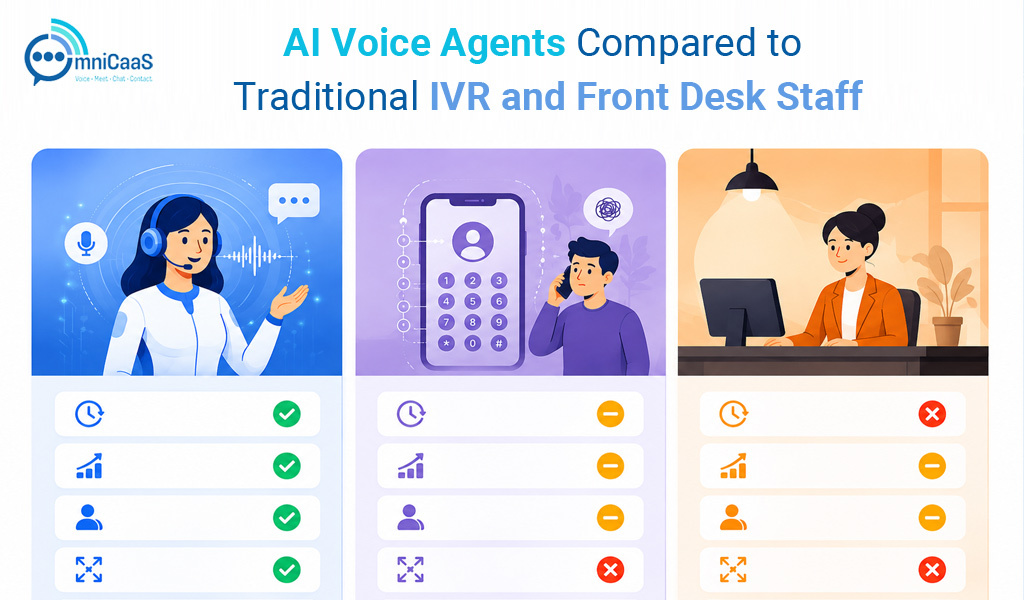
Old style phone trees frustrate patients because they force a series of button presses just to reach a human, and by the time they get there, the wait has already started. AI agent versus IVR comparisons almost always land the same way: patients would rather talk than navigate a menu, and conversion to a booked appointment is noticeably higher when the caller feels heard instead of routed.
Human staff still matter, and no serious deployment tries to remove them entirely. The better model has the AI voice agent handling the routine scheduling calls, the confirmations, the reschedules, the after hours requests, while staff handle the complex cases that genuinely need a person, like a nervous first time patient or a complicated insurance question.
Getting Started With AI Voice Scheduling
Adoption doesn’t require ripping out existing phone infrastructure. Most practices layer an AI voice agent on top of the VoIP services and contact center tools they already run, connect it to the scheduling calendar, and go live in weeks rather than months. It’s worth reading a bit about how practices already use UCaaS in the healthcare industry before choosing a vendor, since scheduling is only one piece of a broader communication setup, alongside secure messaging and patient reminders.
The practices that see the biggest gains are the ones that treat this as a scheduling upgrade first, not a technology experiment. Start with the highest volume call type, usually new patient booking or reminder calls, get that working well, then expand.
What Should a Practice Look for in an AI Voice Scheduling Partner?
Not every vendor is built for healthcare, and that distinction matters more than most sales pages let on. A general purpose call bot built for restaurants or retail won’t understand insurance terminology, appointment types, or the tone a patient expects when discussing a health concern. Look for a provider with real healthcare deployments already running, clear language around data security, and a support team that answers questions during setup rather than disappearing after the contract is signed.
Ask specifically how the system handles a call it can’t complete. The honest vendors will walk through the escalation path in detail, showing exactly when and how a call reaches a human. If a sales rep glosses over that question, treat it as a warning sign, not a footnote.
The Bottom Line
Missed calls and missed appointments both cost a practice money and, more importantly, cost patients timely care. AI voice agents close that gap by answering every call, confirming every visit, and freeing staff to focus on the people already in the building. For a growing number of medical offices, that’s not a future upgrade anymore. It’s already how the phone gets answered.
Post a Comment