

Customer expectations have changed, permanently. Today’s customers don’t think in business hours. They call after work, during weekends, and often across time zones. When a call doesn’t get answered or gets stuck in a line, people lose their tolerance very quickly. This change has forced companies to rethink how they handle large amounts of voice communication.
Enter AI voice agents for business. They are smart, conversational systems that can take calls, answer intuitively, and work all the time. AI voice agents are different from typical IVR menus or voicemail-based systems because they let you have conversations in real time and with an understanding of the situation that feel human.
AI speech agents are no longer just a “nice-to-have” feature for businesses that use modern Unified Communication Systems; they are becoming a key part of how businesses interact with customers.
What Are AI Voice Agents and How Do They Work?
What Is an AI Agent? An AI voice agent is an AI virtual voice assistant that can answer calls, understand spoken language, respond intelligently, and perform tasks without human intervention. These agents rely on a combination of technologies such as Natural Language Processing (NLP), speech recognition, and machine learning.
Here’s how AI voice agents work in practice:
- Instant call answering: When a customer calls your business, the AI voice representative answers promptly. No rings, waits, or voicemail delays.
- Speech-to-intent recognition: The agent utilizes NLP to understand intent, not keywords, from what the caller says.
- Context-aware responses: The AI intelligently replies to callers’ sales, support, appointment booking, and general inquiries.
- Task execution: The AI voice agent can schedule appointments, check order statuses, log service tickets, and capture lead details in real time.
- Smart call routing: AI dispatches calls to the proper department or agent with the complete conversation context if human action is needed.
- CRM and system access: OmniCaaS’s Unified Communication System allows real-time CRM, call history, and business workflow access.
Limitations of Human-Only Call Handling Models
As organizations grow, human agents taking calls could create operational issues.
Manpower, fatigue, shift coverage, and cost limit human teams. Call centers with many staff struggle during peak hours, holidays, and call surges. Missed calls equate to lost revenue, unresolved issues, and unhappy customers who may not call again.
Additionally, inconsistency exists. Different agents may answer the same question, causing uncertainty and brand trust loss. Employee turnover makes training new agents more expensive and time-consuming.
Thus, many companies are supplementing human teams with AI-powered call handling solutions to ensure consistency, reliability, and availability 24/7.
Why 24/7 Availability Is Now a Business Expectation
24/7 availability is no longer global enterprise-only. Even local companies serve instant-access customers.
Customers interact with brands late at night, early in the morning, and globally. A missed 11 PM call could cost a transaction. Support requests left unanswered till morning can result in unfavorable reviews.
With 24/7 AI voice communication, organizations can stay present without hiring more staff. AI voice assistants answer every call, establishing a trustworthy and professional image that current clients value.
How AI Voice Agents Improve Customer Experience
Customer experience is often defined by speed, clarity, and resolution, and AI voice agents excel in all three areas.
Instant call responding gets rid of long wait times. Discussions, not menu trees, guide customers. AI agents can remember what you said, customize their answers, and give you the right information the first time.
When necessary, the AI smoothly passes calls to human operators with all the information they require, without repeating itself. This mixed technique leads to better first-call resolution, easier conversations, and happier customers.
AI Voice Agents vs Traditional IVR Systems
The difference between AI Agents vs Traditional IVR systems is night and day. While traditional IVR systems rely on fixed scripts and keypad inputs, they frustrate callers with endless menus, incorrect routing, and robotic prompts. AI voice agents, on the other hand, listen and respond conversationally.
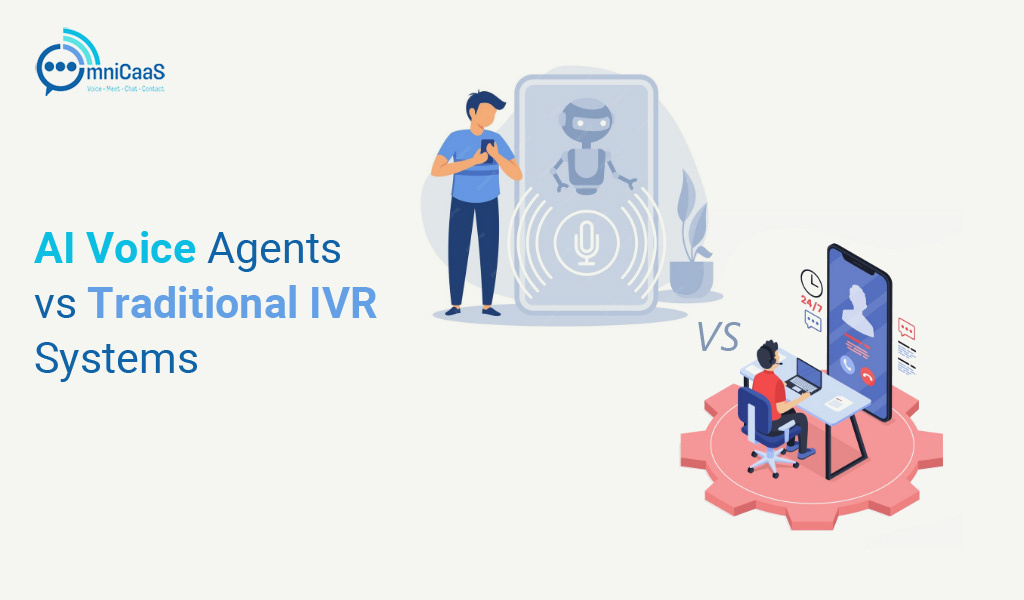
This is why AI agents are changing business communication; they replace friction with fluid conversation.
| Feature | AI Voice Agents | Traditional IVR Systems |
| Interaction Style | Conversational and natural, allowing callers to speak freely | Menu-driven with rigid prompts like “Press 1, Press 2” |
| Understanding Capability | Uses Natural Language Processing (NLP) to understand intent, context, and variations in speech | Limited to predefined keywords or numeric inputs |
| Customer Experience | Feels human-like, intuitive, and responsive | Often frustrating, robotic, and time-consuming |
| Flexibility | Adapts to different customer requests without reprogramming scripts | Requires manual updates and scripting for every change |
| Handling Complex Queries | Capable of managing multi-step and nuanced conversations | Struggles with anything beyond basic queries |
| Scalability | Easily scales to handle high call volumes simultaneously | Limited scalability; performance drops during peak traffic |
| Integration Capabilities | Seamlessly integrates with UCaaS, CRM, and business systems | Minimal or no integration with modern platforms |
| 24/7 Availability | Designed for true 24/7 AI voice communication | Technically available 24/7, but offersa poor after-hours experience |
| Business Impact | Enhances efficiency, customer satisfaction, and revenue opportunities | Often leads to call abandonment and customer dissatisfaction |
Scalability and Cost Savings with AI Voice Solutions
Hiring, training, and keeping call center staff is costly. Seasonal surges and business growth make scaling human teams harder.
AI voice agents are scalable. The system scales without staffing costs from 50 to 5,000 calls. AI-powered call handling solutions are more affordable over time because businesses pay for capabilities, not people.
AI speech agents in cloud-based UCaaS platforms like OmniCaaS offer unrivaled flexibility and cheaper TCO for enterprises compared to Cloud Phone Systems vs On-Premise solutions.
Final Thought
AI voice agents are changing business communication by making it faster, smarter, and always available. As customer expectations continue to rise, businesses that embrace 24/7 AI voice communication will stay ahead, while others struggle to keep up.
With OmniCaaS’s Unified Communication System, AI voice agents become more than automation; they become a competitive advantage.
Post a Comment