Key Takeaways
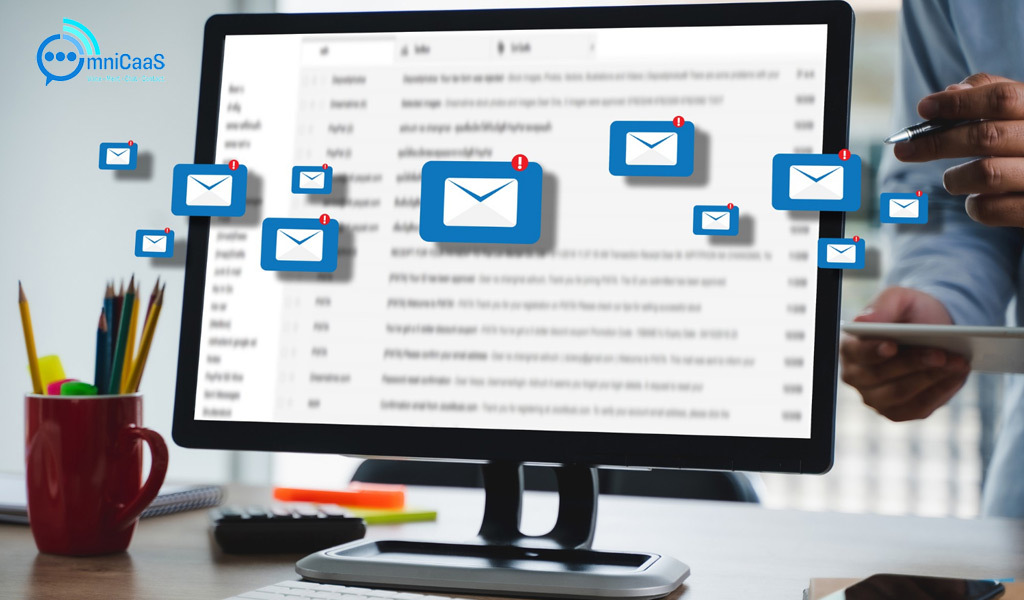
- Fax to email lets you send and receive faxes as digital files through your regular email inbox, no fax machine required.
- It keeps the legal reliability of fax while removing the cost, maintenance, and clutter of physical hardware.
- Healthcare, legal, and finance teams rely on it most because faxed documents are still widely accepted for compliance and signatures.
- It integrates cleanly with cloud phone systems, so businesses can consolidate voice, fax, and messaging into one platform.
- Security features like encryption and audit trails make it far safer than a fax sitting exposed on a shared machine.
- Moving to fax to email is often the easiest first step for businesses ready to move away from outdated office technology.
Fax might sound like a relic of the 1990s office, but it is still one of the most trusted ways to send legally binding documents in industries like healthcare, legal, finance, and real estate. The difference today is that nobody wants a bulky machine sitting in the corner spitting out paper. That is where fax to email comes in, a modern approach that lets your business send and receive faxes directly from an inbox, a browser, or even a mobile device.
This guide breaks down what fax to email actually is, how it works, why it still matters in 2026, and how it fits into a broader cloud communication strategy.
What Is Fax to Email
Fax to email is a service that converts incoming faxes into digital files, usually PDFs, and delivers them straight to a designated email inbox. Outgoing faxes work the same way in reverse. You attach a document to an email, send it to a special fax number, and the service transmits it as a standard fax on the other end.
There is no physical machine, no dedicated phone line, and no paper tray to refill. Everything happens through software, which is why it is often bundled under Fax to Email Communication Software as part of a broader cloud communication package for businesses.
How Fax to Email Communication Software Works
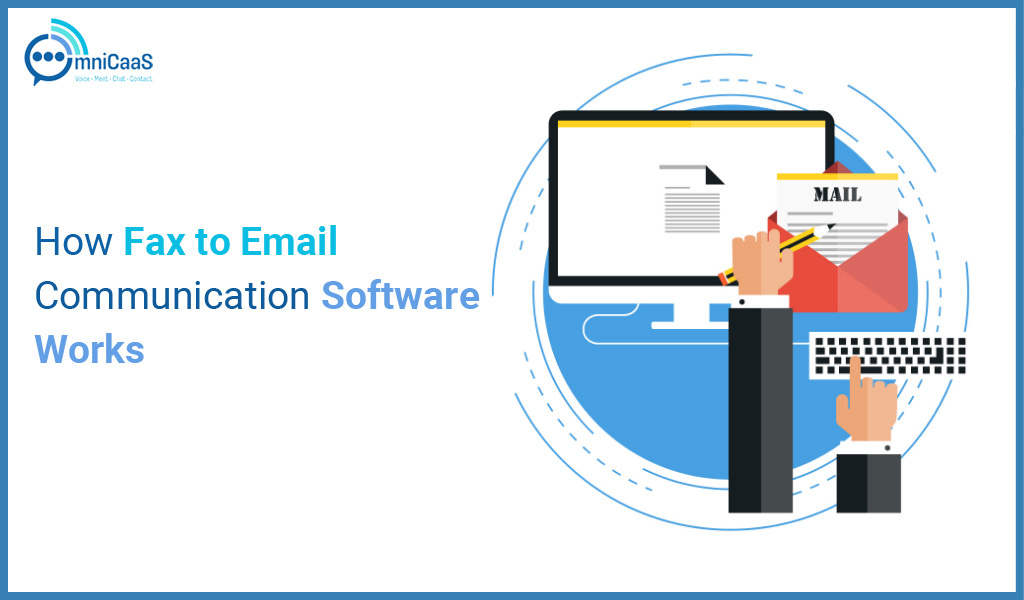
The process is simpler than most people expect.
Receiving a fax: Someone sends a fax to your assigned fax number. The software intercepts the transmission, converts it into a digital document, and emails it to the mailbox or team distribution list you have set up. You can open it on a laptop, tablet, or phone within seconds.
Sending a fax: You compose an email, attach the file you want to send, and address it to a special fax address tied to the recipient’s fax number. The platform converts your attachment into a fax formatted transmission and sends it through the telephone network so the receiving fax machine or fax service picks it up normally.
Because the whole exchange happens over the internet on your end, there is no need to be near a physical machine, and multiple people can access the same fax line without fighting over a single device.
Why Businesses Still Use Fax in 2026
It is a fair question. With email, e signatures, and instant messaging everywhere, why does fax still matter?
The honest answer is regulation and habit. Many government agencies, insurance companies, hospitals, and law firms still require or prefer faxed documents because fax transmissions are treated as more secure and more legally defensible than a plain email attachment. Courts, medical providers, and financial institutions frequently list fax as an accepted method for submitting sensitive paperwork.
Rather than fight that reality, smart businesses adapt by removing the friction. Fax to email keeps the compliance benefits of traditional fax while giving employees a workflow that feels just as easy as sending an email.
Benefits of Fax to Email for Modern Businesses
Lower costs. No dedicated phone line, no toner, no paper, and no maintenance contracts for aging hardware.
Faster access. Documents land in an inbox instead of a shared tray, so the right person sees them immediately instead of digging through a pile of paper.
Better security. Reputable providers encrypt transmissions and keep an audit trail, which matters a great deal for healthcare and legal teams handling sensitive records.
Remote friendly. Staff working from home or across multiple locations can send and receive faxes without ever being near a physical office.
Easier archiving. Digital faxes can be stored, searched, and organized like any other file, instead of sitting in a filing cabinet.
Simplified IT. One less piece of hardware to manage, patch, and eventually replace.
Fax to Email vs Traditional Fax Machines
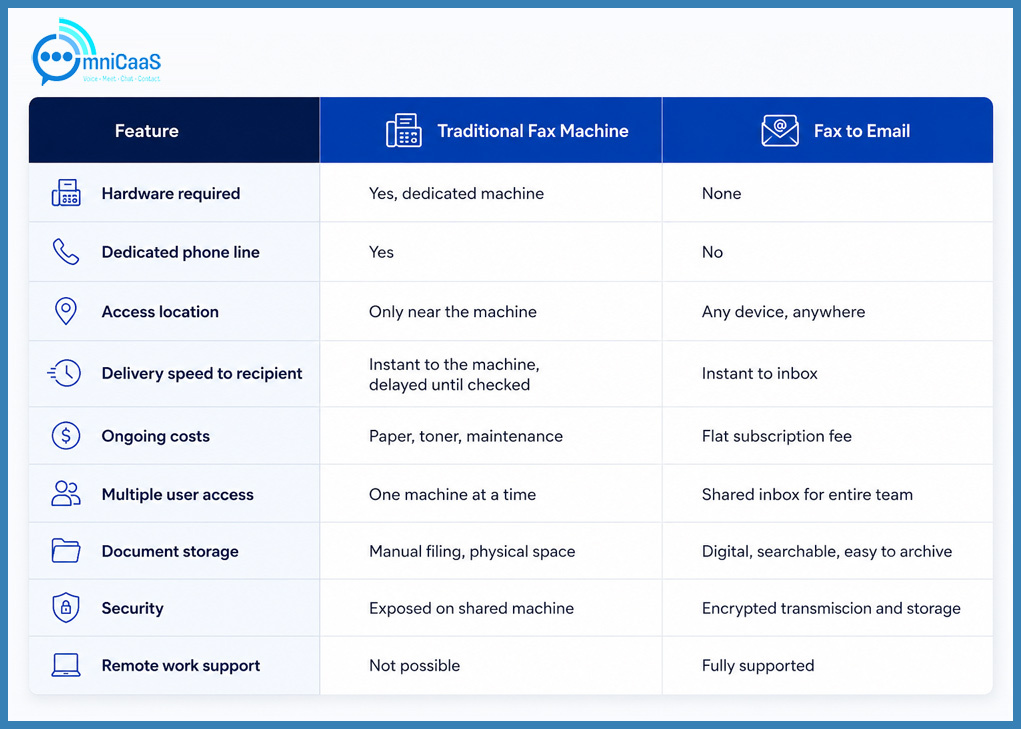
A traditional fax machine ties your business to a physical location, a dedicated phone line, and ongoing supply costs. If the machine jams or runs out of toner at the wrong moment, an important document can be delayed or lost entirely. Only whoever is standing near the machine sees incoming faxes right away.
Fax to email solves all of that. Documents are delivered instantly to the people who need them, regardless of where they are working from. There is no hardware to break down, no supplies to reorder, and no risk of a sensitive fax sitting exposed on a machine in a shared office.
For most modern businesses, the shift from a physical machine to a digital service is an easy decision once the comparison is laid out this clearly.
How Fax to Email Fits Into a Modern Communication Stack
Fax to email rarely exists in isolation anymore. It usually sits alongside voice, video, messaging, and increasingly, AI driven tools inside a single unified platform. Businesses that pair fax to email with AI voice agents get a front office that answers calls around the clock while back office paperwork keeps flowing digitally, all without adding staff.
This kind of consolidation is part of a larger trend where companies choose to replace legacy phone system infrastructure with a single cloud based platform that handles calling, faxing, messaging, and automation together. Instead of managing separate vendors for phones, fax lines, and video conferencing, everything runs through one dashboard with one bill.
Providers like Omnicaas build fax to email as one piece of that larger communication suite, so a business upgrading its phone system does not need a separate project just to modernize its fax line.
Choosing the Right Fax to Email Provider
When comparing providers, look for a few things beyond price. Confirm the platform offers encryption for stored and transmitted documents, since compliance heavy industries cannot afford weak security. Check whether faxes can be routed to multiple team members or shared inboxes, not just one person. Ask about reliability guarantees, since a missed fax in healthcare or legal settings can carry real consequences. Finally, consider whether the provider bundles fax to email with voice and other communication tools, since a unified platform is almost always simpler to manage than juggling separate vendors.
Final Thoughts
Fax is not disappearing anytime soon, especially in regulated industries, but the way businesses handle it absolutely should evolve. The same trusted, compliant document exchange that fax-to-email provides, without the cost, clutter and limitations of a physical machine. Pair that with modern tools like cloud phone systems and AI-driven call handling and you have one small but meaningful piece of a business that runs on modern infrastructure, not outdated hardware.
Post a Comment