
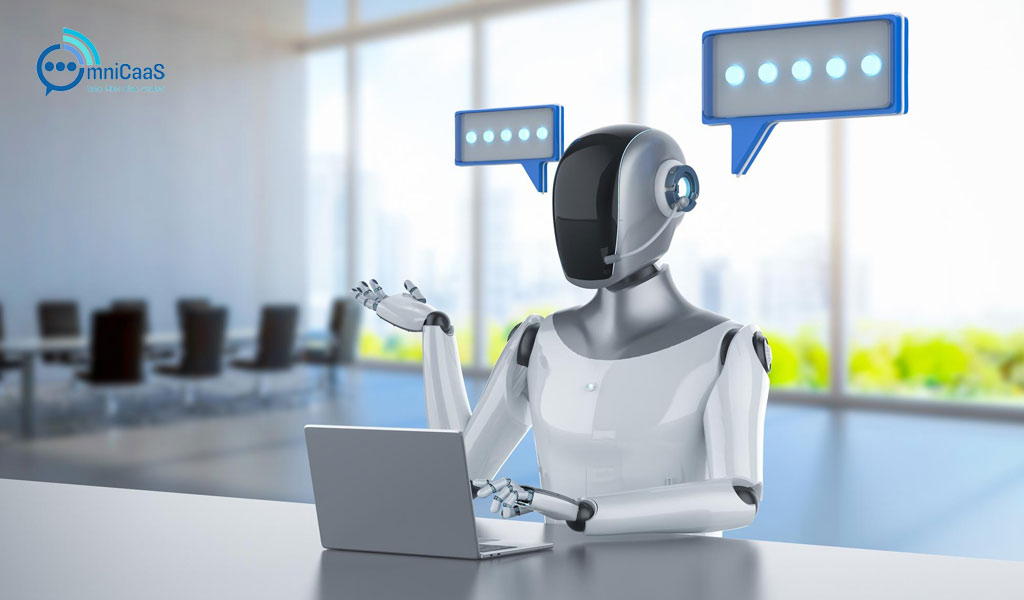
In 2025, the word “AI agents” is getting more prominent. AI is already a normal element of running a business. AI Agents are no longer just a buzzword; they are already a very important aspect of modern business.
These intelligent, self-driving gadgets are transforming how businesses talk to each other, aid customers, streamline internal processes, and take care of routine tasks. AI agents can do a lot more than just analyze natural language. They can also make decisions, solve problems, interact with the outside world, and carry out tasks.
AI agents for business are becoming the unseen workers that keep things running smoothly, no matter what kind of communication platform, customer service chat tools, or UCaaS solutions your company utilizes to bring your teams together.
What Is an AI Agent?
An AI agent is an element of software that can see, process, and act on information on its own in order to reach a certain goal. An AI agent is different from basic AI models because it can think, make decisions, and act based on the rules and goals it has been given.
An AI agent is like a digital worker in real life. It can follow directions, get data from your systems, talk to customers or employees, and finish activities without needing to be watched all the time.
It is like a smart computer helper that can see what’s going on around it, interpret information, and make choices to get things done. It’s like how you learn from your mistakes to do better next time. It’s like a really smart digital helper that never gets tired and is great at fixing things.
For example, in a Unified Communications system, an AI agent can route calls intelligently, support customers with self-service, figure out how individuals are feeling during conversations, or take care of back-end tasks automatically. Many businesses that use platforms like Cisco Unified Communications Manager or UCaaS providers like OmniCaaS use AI agents to automate tasks and make phone, chat, SMS, and email more efficient.
What Does an AI Agent Do?
AI agents support businesses across many communication and operational tasks. Depending on how they are designed, they can:
- Respond to customer inquiries via chat, voice, or messaging
- Provide real-time assistance to call center teams
- Route calls with precision using call routing best practices
- Schedule appointments or send reminders
- Analyze customer sentiment during live interactions
- Pull or update information in CRMs and ticketing systems
- Trigger automated workflows across multiple business applications
- Monitor patterns for cybersecurity for small businesses
The key advantage? AI agents complete tasks, not just answer questions. They follow predefined goals, such as resolving a ticket, escalating a support case, or completing a transaction, and take the steps required to reach that outcome.
What Can an AI Agent Read or Use?
AI agents operate using a wide range of data sources and system inputs. Depending on permissions and integrations, an agent can read or access:
- Customer profiles and historical interactions
- Ticketing and CRM data
- Knowledge bases and FAQs
- Product catalogs and service documentation
- Email or chat transcripts
- Voice call data or recordings (converted to text)
- Website behavior and form submissions
- Internal workflows and business rules
- UCaaS system logs, call routing histories, and performance metrics
- Security alerts for cybersecurity monitoring
Businesses can implement fine-grained access controls for agents to safeguard sensitive data. Intelligent agents in AI can only work securely and to their full potential with solid governance in place.
What Is the Difference Between AI and AI Agents?
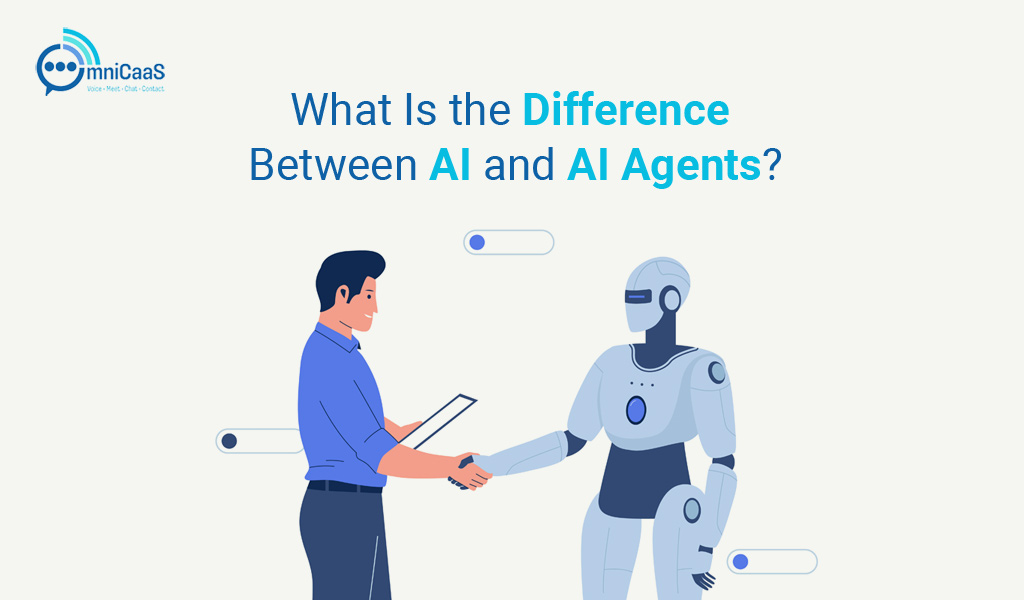
AI is the technology. AI agents are the application of that technology.
Artificial Intelligence (AI)
AI is an umbrella term for computer programs designed to mimic human intellect. Things like predictive analytics, natural language processing, and machine learning models fall under this category.
AI Agents
AI agents use one or more AI techniques to autonomously perform tasks. While AI can analyze text or generate responses, an AI agent uses that understanding to take action according to goals and rules.
In simple terms:
AI is the brain.
AI agents are the employees powered by that brain.
Components of an AI Agent
Every functional AI agent is built from several key components:
1) Perception Layer
It gets information from the outside world, like text, speech, data logs, and consumer questions.
2) Reasoning Engine
Processes data to figure out the context, the purpose, and the next steps. This usually comprises business logic, machine learning, and NLP.
3) Knowledge Base
Holds useful information like policies, documents, customer history, workflows, and so on.
4) Action Layer
This layer does things like making tickets, answering messages, routing calls, updating databases, or starting workflows.
5) Feedback Loop
Lets the agent get better at making decisions and get more accurate over time.
These elements allow agents connect talking to doing, which is a very useful feature for places like modern call centers that use a lot of automation.
Types of AI Agents
AI agents vary depending on complexity, autonomy, and function. Here are the most common types used in business:
1) Reactive Agents
Respond instantly to situations without using past memory. Many basic chatbots fall into this category.
2) Goal-Based Agents
Make decisions based on defined business objectives (e.g., minimize call wait times, resolve customer issues quickly).
3) Utility-Based Agents
Evaluate multiple possible actions and choose the one that maximizes a “utility score,” such as customer satisfaction.
4) Learning Agents
Improve over time using machine learning, feedback, and pattern recognition.
5) Multi-Agent Systems
A network of AI agents that collaborate, one may route calls, another may handle queries, and another may monitor security.
For businesses moving toward AI automation tools, learning agents and multi-agent systems deliver the most long-term ROI.
AI agents are changing the game when it comes to customer care, automating processes, and communicating within a company. They are different from simple conversational AI since they can act on facts, make decisions, and do activities on their own. AI agents for businesses are changing the way modern companies view efficiency in areas such as customer service, internal workflows, call routing, and security monitoring.
Companies leveraging UCaaS solutions like OmniCaaS and enterprise communication managers such as Cisco Unified Communications Manager are already seeing the benefits, from faster support to smarter AI automation tools across departments.
AI agents aren’t just the future; they are the competitive advantage businesses need today.
Post a Comment