
It’s no longer easy to choose the correct phone system for your business. It’s a smart method to spend money on how your firm talks to each other, works together, and grows. Companies have to choose between two main types of phone systems: cloud phone systems and on-premise phone systems. This is because teams are becoming more spread out, customers are expecting more, and digital transformation is happening faster.
Both are strong in their own ways, but they are best for different kinds of businesses and ways of communicating. Knowing how each system works and how those variations affect cost, flexibility, security, and scalability can help you choose the one that best supports your company’s long-term goals.
Introduction
Business communication is evolving at a rapid pace. What used to be a basic PBX in a server room has now become complex, cloud-hosted communication platforms that can support teams all over the world. But as more alternatives become available, a lot of firms are wondering, As part of this evolution, Why Businesses Are Adopting AI Voice Agents has become an important question, especially as more alternatives become available and firms are wondering, “Should we move our communication system to the cloud or keep it on-premises?
This isn’t just a concern of technology; it also influences how customers feel, how productive teams are, how well operations run, and the budget.
Cloud phone systems promise flexibility and ease of use, while on-premise solutions provide you with more control and a sense of familiarity.
Understanding Cloud Phone Systems
Cloud phone systems, commonly known as hosted PBX or VoIP platforms, deliver communication services over the internet rather than via physical equipment installed onsite. Your provider’s geographically scattered data centers handle all routing, call handling, updates, and storage.
Cloud phone systems are different because they turn your communication infrastructure from a capital cost into a service, giving you a contemporary and adaptable way to communicate.
How Cloud Phone Systems Work
When a user makes or receives a call, the voice data is transmitted over the internet to the provider’s servers. These servers handle everything, such as call routing, voicemail, recording, analytics, and feature delivery, before sending the call back to the intended recipient.
Because everything is cloud-managed, businesses gain:
- Instant access to new features
- Automatic software updates
- Built-in disaster recovery
- Mobile and remote working capabilities
- Scalability without buying hardware
Companies with hybrid or remote teams often choose cloud phone systems for their agility and simplicity.
Understanding On-Premise Phone Systems
Physical PBX gear placed in your facility is what makes on-premise phone systems work, with your IT staff responsible for managing, maintaining, and updating the system. In the past, these systems relied on analog or PRI lines, though many modern setups now use VoIP SIP trunks. When it comes to call handling, the PBX hardware acts as the command center for every call your business makes or receives—managing internal extensions, call routing, user access, and voicemail.
This is where the comparison of AI Agents vs Traditional IVR becomes relevant, as on-premise systems typically depend on traditional IVR logic, with all call processing and operations occurring locally rather than through cloud-based AI intelligence.
This setup appeals to businesses that prefer:
- Maximum control over the communication infrastructure
- On-site data storage and security
- Custom hardware-based integrations
- Predictable long-term ownership
- A reliance on internal IT teams
On-premise systems are especially common in sectors with strict compliance requirements or in organizations that have already invested significantly in PBX hardware.
Key Differences Between Cloud and On-Premise Solutions
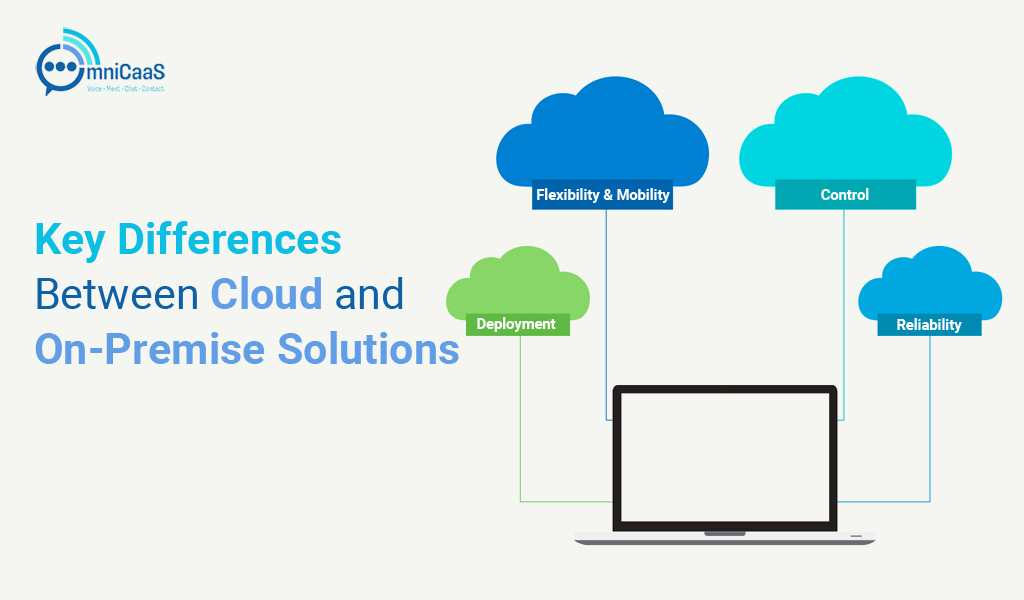
Both systems let people talk to each other, but their design, management, and long-term use are very different.
1) Deployment
Cloud systems require no hardware installation. Users simply log in, connect devices, and begin calling.
On-premise systems require professional installation, wiring, servers, and physical equipment.
2) Flexibility & Mobility
Cloud systems allow employees to work from anywhere using mobile apps, softphones, or desk phones.
On-premise systems restrict mobility unless businesses set up complex VPNs or remote extensions.
3) Control
On-premise gives you total control over how your phone system is configured and secured.
Cloud phone systems shift control to the provider for easier management but less customization.
4) Reliability
Cloud platforms rely on multiple global data centers, offering redundancy and built-in failover.
On-premise systems depend on your local environment—if your building goes offline, so does your phone system.
Scalability and Flexibility
Cloud systems are meant to be easy to expand. Adding or removing users merely takes a few minutes, and you don’t need any more hardware, wiring, or planning for capacity.
This flexibility supports:
- Seasonal workforces
- Distributed teams
- Multi-location operations
- Fast-growing startups
Your communication system adapts as your business evolves.
On-premise systems scale only when you expand hardware capacity. If you run out of ports or system capacity, you must purchase additional modules or entirely new equipment.
Security and Data Control Considerations
Security often becomes one of the biggest deciding factors when comparing cloud phone systems with on-premise solutions.
Your cloud provider is in charge of keeping your communication environment safe. This includes everything from encrypting voice data to keeping an eye on their whole network for strange activities.
Because providers operate large-scale infrastructures, they typically invest in advanced security tools and processes that many businesses cannot cost-effectively implement on their own.
Your internal team is responsible for all security when you use on-premise technology. When you use cloud solutions, security rules are set up ahead of time and monitored from a single location. With on-premise technology, you have complete control over every layer of protection.
This includes:
- How voice data is stored and encrypted
- Firewall configurations and penetration testing schedules
- Strict access controls managed internally
- Custom security rules tailored to your environment
- On-site physical security for servers and equipment
These systems are often preferred by businesses in highly regulated sectors, such as finance, government, and healthcare, where data residency, internal control, or compliance mandates dictate how communication data must be handled.
However, with such authority comes great responsibility and accountability. Your team has to always be on the lookout for updates, fixes, and monitoring. Cloud companies usually fix problems instantly, but any mistake or delay might make things less secure.
As more and more firms adopt remote work and digital transformation, cloud-based unified communication is becoming the most popular option because it is flexible, cost-effective, and ready for the future.
OmniCaaS supports businesses across all industries with robust, secure, and scalable UCaaS solutions designed to grow alongside your operations, helping you communicate smarter, faster, and more effectively.
Post a Comment