Customer support used to mean a supervisor pulling random call recordings on a Friday afternoon, jotting notes, then hoping the team applied the feedback. That model misses 99% of what actually happens on the phone. AI call analytics fixes that gap. It listens to every conversation, scores every interaction, and flags the patterns no human reviewer would catch in a year of spot-checks.
For businesses running high call volumes (healthcare practices, real estate offices, hospitality groups, law firms, professional services teams) the financial case is hard to ignore. A single missed renewal worth $4,000 pays for a year of analytics. A 15-second reduction in average handle time across a 20-seat call center returns hundreds of agent hours each month.
This guide breaks down how AI call analytics works, what it actually measures, and how to pick a tool that fits your business model. It is written for operators who care about results, not vendor brochures.
What Is AI Call Analytics?
AI call analytics is software that uses speech recognition, natural language processing, and machine learning to convert spoken conversations into structured data. Where traditional quality monitoring relies on supervisors listening to a sample of calls, AI call analytics processes 100% of conversations and surfaces what matters.
The category sits at the intersection of speech analytics software and customer support analytics. Older tools transcribed calls and ran keyword searches. Modern call center AI tools go further. They understand intent, detect emotion, correlate behavior with outcomes, and feed data directly into CRM and contact center platforms.
For a Florida UCaaS provider, AI call analytics is part of a broader Unified Communication System. Calls, video meetings, chats, and SMS conversations all flow into the same analytics layer. You get one view of the customer voice across every channel, not five disconnected dashboards.
The business value shows up in four measurable buckets: lower operating cost, higher revenue per call, faster issue resolution, and a stronger compliance posture. Most teams see meaningful results inside 60 days.
How AI Analyzes Customer Conversations
A typical AI call analytics workflow runs in four steps:
- Capture and transcribe: Every inbound and outbound call is recorded (with consent flags handled per TCPA rules) and converted into searchable text. Diarization separates speakers so the system knows who said what.
- Extract meaning: Natural language processing models tag the transcript for intent, topic, entities (product names, dollar amounts, policy numbers), and outcome.
- Score the interaction: Each call gets scored against your quality criteria: greeting compliance, hold time, empathy markers, upsell attempts, resolution status.
- Surface insights: Dashboards roll up scores into trends. Alerts fire when something breaks pattern, like a spike in cancellation language or a drop in first call resolution.
The technical pieces matter less than what they enable. You stop sampling calls and start measuring everything. You stop arguing about anecdotes and start operating from data.
Identifying Customer Pain Points
Pain points hide in the calls nobody reviews. A frustrated customer rarely fills out a survey. They just stop calling, or worse, they call your competitor.
AI call analytics surfaces friction in two ways. First, it tracks repeat callers. If 12% of your customers call back within 48 hours, that is a first call resolution problem the analytics layer will quantify down to the topic and the agent. Second, it tracks negative language patterns. Phrases like “this is the third time,” “nobody told me,” or “I want to cancel” get flagged automatically.
A property management group running OmniCaaS analytics discovered that 31% of after-hours calls came from tenants asking about a single billing question. Two weeks later they updated the welcome IVR with a self-service option for that exact query. After-hours call volume dropped 28%. The same kind of insight is invisible without analytics on every call.
Measuring Agent Performance
Traditional QA scoring covers maybe 2 to 4% of calls per agent per month. AI call analytics scores every call, every agent, every day. That changes what management can act on.
Performance dimensions tracked by most modern systems include:
- Adherence to script and compliance disclosures
- Average handle time benchmarked against team median
- Empathy and tone markers
- Successful upsell or cross-sell attempts
- Hold count and hold duration
- Customer sentiment from call open to call close
- Resolution status confirmed by closing language
The fairness gain matters. When every call is scored, top performers can no longer be ignored and weaker performers can no longer hide. Coaching becomes specific. Instead of “you need to sound more empathetic,” a manager can point to the exact 90-second segment where the customer’s tone shifted and ask the agent to listen.
Sentiment Analysis in Calls
Sentiment analysis interprets the emotional tone of a conversation. It looks at word choice, vocal pitch, speaking rate, and pauses to score each speaker on a positive-to-negative scale across the full call timeline.
The value is not the dashboard chart. It is the early warning system. A customer who starts a call at neutral and ends at negative is a churn risk you can act on within 24 hours. A customer who starts negative and ends positive is a case study you can use in coaching.
Multilingual sentiment matters in Florida specifically. With 33.2% of South Florida small businesses Hispanic-owned, bilingual customers move between English and Spanish inside a single conversation. AI call analytics platforms with 40+ language support pick up sentiment shifts regardless of which language the customer slips into. Single-language tools miss half the signal.
A note on accuracy. Sentiment scoring is not perfect. Sarcasm, regional accents, and industry jargon can throw off any model. Treat it as one input, not the verdict. Used well, it points the supervisor at the right 10% of calls to review personally.
Reducing Call Handling Time
Average handle time (AHT) is one of the few metrics that touches both cost and experience. Cutting AHT by 30 seconds across a 25-seat operation saves roughly 4 hours of labor per day, or about $30,000 per year in fully-loaded agent cost.
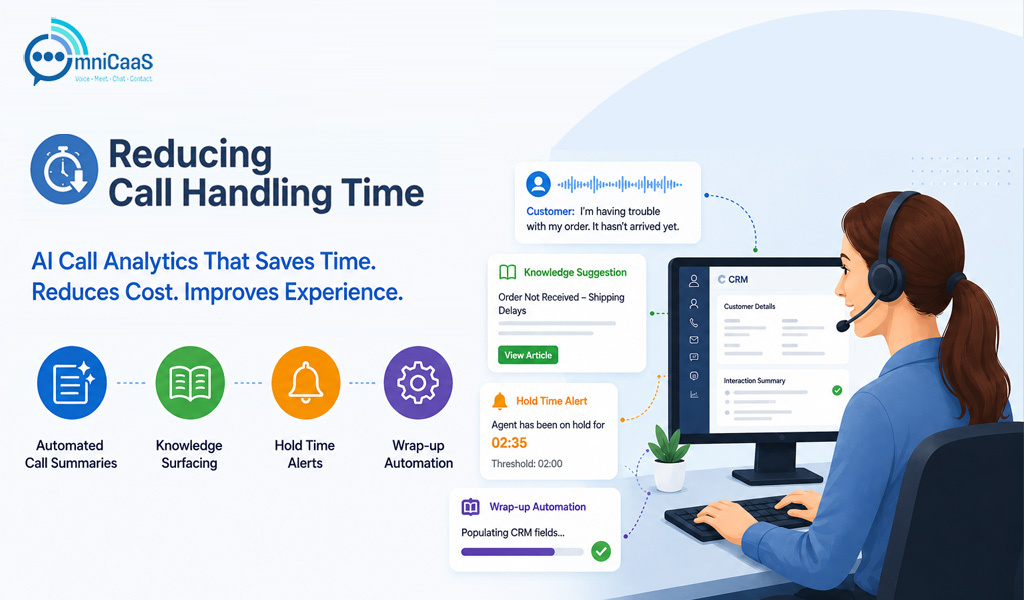
AI call analytics cuts AHT in four practical ways:
- Automated call summaries. Post-call notes that used to take 90 seconds get generated in real time. Agents move to the next call faster.
- Knowledge surfacing. As the customer describes the issue, the system pulls the matching knowledge base article onto the agent’s screen.
- Hold time alerts. Supervisors get notified when an agent has been on hold longer than threshold so they can intervene before the customer hangs up.
- Wrap-up automation. CRM fields populate automatically from the transcript, eliminating manual data entry.
The trade-off is real. Push AHT too low and quality drops. The right benchmark depends on your industry. A SaaS support call should run differently than a real estate inquiry. Analytics gives you the data to set that benchmark instead of guessing.
Improving First Call Resolution
First call resolution (FCR) is the single best predictor of customer satisfaction and retention. Every repeat call costs you twice: once in operating expense, once in customer trust.
AI call analytics improves FCR by tying outcomes back to causes. When a customer calls back about the same issue within seven days, the system links the two conversations, identifies the original agent, the original resolution attempt, and the topic. Patterns emerge fast.
You will typically find one of four root causes behind low FCR:
- The knowledge base is wrong or out of date
- The CRM is missing a key field the agent needed
- A specific topic requires escalation that is being skipped
- An agent or team needs targeted coaching on one issue type
Each root cause has a fix that costs almost nothing to implement once you have identified it. The real cost is finding it in the first place. Without analytics, most teams never do.
Personalizing Customer Interactions
Personalization in customer support means knowing who the customer is, what they have called about before, and what matters to them, before the agent says hello. AI call analytics powers this by linking conversation history with CRM data and surfacing the context at the start of every interaction.
Practical applications include:
- Returning callers identified by phone number get routed to the agent who handled their last call
- Customers with a recent negative sentiment score get flagged for VIP handling
- Spanish-preference callers route automatically to bilingual agents
- Healthcare callers get matched to agents trained on HIPAA-sensitive topics
- High-value accounts skip the queue and reach a senior representative directly
A real estate firm running OmniCaaS analytics saw a 19% lift in appointment-set rate after enabling intent-based routing. Calls that contained early purchase signals (mentions of “ready to move,” “pre-approved,” specific neighborhoods) skipped general intake and went directly to a closer. Same call volume, more revenue.
Tracking Trends and Common Complaints
Individual calls are anecdotes. Trends are evidence. AI call analytics aggregates topics, sentiment, and outcomes across thousands of conversations to show you where your business is shifting.
Common trend reports include topic frequency over time, sentiment drift by product or service line, new complaint categories that did not exist 30 days ago, geographic clusters of issues, and channel migration patterns (callers who used to email now calling).
This data is not just for support. It belongs to product, marketing, and operations.
Product teams see which features generate the most “how do I” calls and can fix the UX. Marketing sees which campaigns drive confused inbound calls (a sign the messaging is misleading). Operations sees which suppliers or service providers create the most complaint volume.
For Florida businesses, hurricane season produces predictable call pattern shifts. Analytics tools that flag these shifts a week early give operations time to staff up before the storm rather than scrambling during.
Improving Training with Data Insights
Most call center training fails because it is generic. New hires sit through 40 hours of slides covering scenarios they may never see, then start taking calls with the same gaps as everyone before them. AI call analytics flips the model.
When every call is transcribed and scored, the system builds a library of real interactions tagged by outcome. Training shifts from hypothetical role-play to real examples:
- The top five calls from your highest-performing agent become a benchmark library new hires study
- Calls that resulted in successful retention or upsell get isolated for technique analysis
- Common mistakes (skipped disclosures, poor objection handling, missed empathy cues) get compiled into a “what to avoid” module
- Coaching sessions reference specific timestamps from the trainee’s own calls, not abstract principles
The financial impact compounds. A new agent reaching full productivity in 6 weeks instead of 12 saves roughly $4,000 to $6,000 in fully-loaded ramp cost per hire. For a Florida hospitality operation onboarding 30 seasonal agents, that is a $120,000-plus annual saving.
Read More About : AI Phone Systems for Small Businesses in 2026
Boosting Customer Satisfaction
Customer satisfaction scores are downstream of every other metric in this guide. When handle times drop and first call resolution rises and agents have better information, satisfaction follows. The data shows it clearly.
AI call analytics also creates a direct feedback loop. Post-call surveys can be triggered intelligently based on conversation content rather than blasted to every caller. Customers who had a clearly positive interaction get asked for reviews. Customers who showed friction get a follow-up call from a supervisor before they post a negative review online.
The reputation effect matters for Florida-based businesses competing in markets where Google reviews drive 60 to 70% of new customer acquisition. A single bad review on a service business can suppress conversion for months. AI call analytics catches those moments before they hit the public review platforms.
Bilingual satisfaction is also worth measuring separately. South Florida operations consistently score lower CSAT among Spanish-preference callers when service is English-only. Analytics surfaces that gap by language so you can solve it with bilingual staffing or AI agents rather than guess.
Choosing the Right AI Call Analytics Tool
The market is crowded. Most tools demo well and underperform once you depend on them. Use these criteria to filter:
Integration depth. The analytics layer is only valuable if it connects to your phone system, CRM, ticketing platform, and reporting stack. Ask about pre-built connectors, not promises of “API availability.”
Multilingual support. If your customer base includes Spanish, French Creole, or Portuguese speakers, English-only analytics misses real signal. Look for platforms that handle at least the languages you actually serve, with sentiment scoring per language.
Compliance posture. HIPAA, TCPA, and Florida-specific call recording rules apply. Tools without explicit compliance documentation create regulatory risk. For healthcare and legal clients, this is non-negotiable.
Accuracy benchmarks. Ask for vendor accuracy data on calls similar to yours, not generic marketing claims. A 95% transcription accuracy in a quiet studio does not translate to a noisy call center.
Pricing model. Per-minute pricing punishes growth. Per-seat pricing rewards adoption. Per-call pricing creates strange incentives. Pick a model that aligns with how your team actually uses the tool.
Time to value. Implementation that takes 6 months kills momentum. Florida-based UCaaS providers like OmniCaaS deploy AI agents and analytics in 48 hours because the underlying Cloud Phone Systems vs On-Premise architecture is built for fast onboarding. If a vendor needs a quarter to get you live, ask why.
Florida and regional fit. Hurricane preparedness, bilingual market support, and local data residency matter more for Florida operators than for national buyers. National Leading Business Phone System Providers can deliver capabilities, but rarely the local context.
The right tool depends on call volume, vertical, and existing infrastructure. For a 25 to 50 seat operation in Florida running on legacy on-premise PBX, the AI Agents vs Traditional Call Handling decision often comes down to a single number: up to 85% cost savings versus continued staffing pressure. That math is hard to ignore.
If you are evaluating options, OmniCaaS offers both the unified communications layer and AI call analytics built on top of it, starting at $750 per month for AI agents and bundled with UCaaS. The free voice demo runs through a typical inbound flow so you can hear what your customers would hear.
Ready to see AI call analytics in action? OmniCaaS offers a free AI voice demo that walks you through a typical inbound flow, plus a calculator that estimates your potential cost savings against your current call center staffing model. Both are free, and both take less than 10 minutes.
Book a demo at omnicaas.com or call our Florida team to get started in 48 hours.
Post a Comment