

Modern businesses rely on fast, reliable communication to stay competitive. As customer expectations grow, organizations are turning to smarter communication tools that improve responsiveness and efficiency. This is where UCaaS platforms and AI voice agents come together.
Unified Communications as a Service (UCaaS) provides a centralized communication environment, while AI voice agents introduce intelligence and automation into business conversations. Together, they create advanced cloud communication systems that improve collaboration, streamline customer support, and enhance productivity.
Businesses adopting conversational AI for business are discovering that combining UCaaS with AI agents is not just an upgrade; it is a transformation in how organizations communicate internally and with customers.
What Is UCaaS?
Unified Communications as a Service (UCaaS) is a cloud-based communication solution that integrates voice calling, video meetings, messaging, and collaboration tools into a single platform.
Instead of managing multiple disconnected tools, businesses can operate through a single system that supports communication across teams and locations.
UCaaS solutions typically include:
- Cloud telephony
- Video conferencing
- Team messaging
- File sharing
- Collaboration tools
- Presence indicators
Modern UCaaS platforms simplify communication infrastructure while improving efficiency and scalability. With solutions like OmniCaaS, organizations can unify communication channels and support hybrid and remote work environments with ease.
What Are AI Voice Agents?
AI voice agents are intelligent, software-driven assistants designed to communicate with customers and employees through natural, human-like conversations.
Unlike older automated systems that rely on rigid scripts or button-based menus, modern AI voice agents can hold dynamic conversations that feel natural and intuitive.
At their core, AI voice agents are a form of conversational AI for business, enabling organizations to automate voice interactions without sacrificing quality or personalization. When a customer calls, the AI voice agent can greet them, identify the reason for the call, and either resolve the issue directly or route the request appropriately.
Within modern cloud communication systems, AI voice agents operate as intelligent front-line assistants. They integrate seamlessly with business tools such as customer relationship management (CRM) platforms, helpdesk software, and knowledge bases, enabling them to provide informed and relevant responses.
For example, an AI voice agent can recognize a returning customer, access their account history, and provide tailored assistance without requiring manual input from a human agent.
Also Read Cloud Phone Systems vs On-Premise: Which One Fits Your Business Needs?
How UCaaS Connects Voice, Video, and Messaging
Unified Communications as a Service (UCaaS) brings together multiple communication channels, including voice calls, video meetings, instant messaging, and collaboration tools, into a single, cloud-based environment. Instead of relying on separate applications for each form of communication, businesses can manage all interactions through one unified platform.
With modern UCaaS platforms, users can easily move between communication modes depending on the situation. This flexibility improves productivity and reduces the delays often caused by disconnected communication tools.
UCaaS also ensures that communication data remains synchronized across channels. Call histories, messages, meeting records, and shared files are accessible within the same platform, making it easier for teams to stay informed and aligned. This unified structure is especially valuable for distributed teams that rely on reliable cloud communication systems to collaborate effectively from different locations.
Role of AI in Modern Business Communication
Artificial intelligence is playing a transformative role in modern business communication by introducing automation, intelligence, and data-driven insights into everyday interactions. As organizations increasingly adopt UCaaS platforms and advanced cloud communication systems, AI is becoming a core component that helps businesses communicate faster, smarter, and more efficiently.
1. Smart Recommendations and Decision Support
AI enhances business communication by providing intelligent recommendations based on real-time data and historical interactions. Within communication platforms, AI can analyze patterns such as frequent customer inquiries, peak call times, and common support issues to offer suggestions that improve efficiency.
For example, AI systems can recommend the best available agent for a call based on expertise, workload, or past interactions with the customer. AI can also suggest responses to common questions, helping agents resolve issues faster without needing to search through documentation manually.
2. Automated Workflows and Task Execution
One of the most valuable contributions of AI in communication platforms is workflow automation. AI can automatically perform repetitive communication tasks that would otherwise require manual effort from employees.
Automation reduces administrative work and allows teams to focus on meaningful conversations and problem-solving rather than routine processes. Over time, this leads to improved productivity and smoother business operations.
3. Speech Recognition and Natural Conversations
Modern AI voice agents rely on advanced speech recognition and natural language processing to understand spoken language and respond conversationally. This capability allows customers to communicate naturally instead of navigating rigid menus or scripted interactions.
AI can interpret different accents, speaking styles, and phrasing variations, making communication more accessible and user-friendly. It also understands intent rather than simply detecting keywords, allowing for more accurate and helpful responses.
4. Meeting Intelligence and Productivity Tools
AI is also improving internal business communication by enhancing meetings and collaboration sessions. Many modern communication platforms now include AI-powered features that help teams stay organized and productive.
AI can automatically transcribe meetings, generate summaries, identify action items, and highlight key discussion points. Employees who miss a meeting can quickly review AI-generated notes instead of watching an entire recording.
These capabilities save time and ensure that important information is not lost. Teams can stay aligned even when working across different time zones or schedules.
5. Real-Time Insights and Communication Analytics
AI enables businesses to gain deeper visibility into communication performance through advanced analytics. AI-powered insights allow organizations to track metrics such as call volumes, response times, resolution rates, and customer sentiment.
Real-time analytics also allow managers to monitor communication quality and adjust resources quickly during busy periods. This ensures that customers receive consistent service even when demand fluctuates.
6. Intelligent Assistants and Continuous Support
AI-powered assistants are becoming an integral part of business communication environments. These assistants can help employees perform tasks such as scheduling meetings, retrieving customer information, or sending messages without leaving the communication platform.
For customers, AI assistants provide immediate support by answering questions, guiding users through processes, and resolving common issues. Because AI assistants operate continuously, businesses can provide reliable service beyond traditional working hours.
Also Read The Future of Business Communications: AI, UCaaS & VoIP
Smart Call Routing and Faster Response
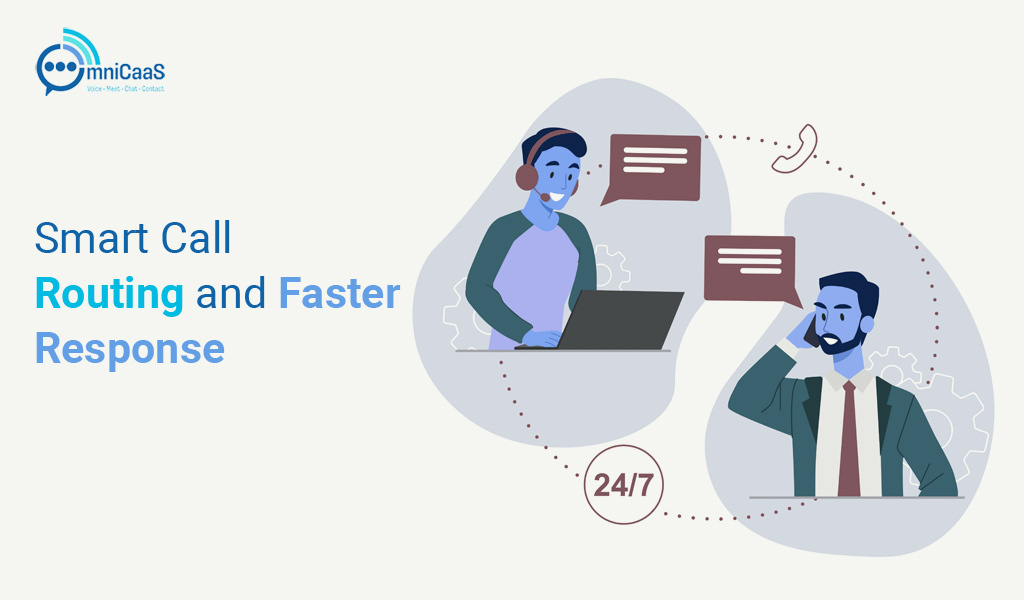
Smart call routing is one of the most powerful capabilities that emerges when AI voice agents are integrated into modern UCaaS platforms.
Using AI-powered call routing, the system can identify the caller’s intent through natural conversation instead of relying on button-based selections. For example, a customer might simply say, “I need help with my billing,” and the AI voice agent can instantly route the call to the billing team or even provide assistance directly.
AI routing systems can also consider additional factors such as agent availability, expertise, past customer interactions, and priority levels.
A returning customer with an open support ticket can be directed to the same agent or department that previously handled their issue, ensuring continuity and faster resolution. This intelligent distribution of calls helps businesses operate more efficiently while improving service consistency.
Within advanced cloud communication systems, smart routing also supports peak demand by balancing call volumes across available agents or locations.
Whether a business is handling a surge in customer inquiries or supporting multiple time zones, AI-driven routing ensures that communication remains smooth and responsive.
Why Businesses Are Adopting AI Voice Agents
1. Faster Response Times
Customers today expect immediate assistance, and long wait times often lead to frustration or lost business. AI voice agents can answer calls instantly, eliminating the delays associated with traditional call queues. Instead of waiting for an available agent, callers can begin interacting with the system right away and receive quick answers to common questions.
2. Reduced Operational Costs
One of the major reasons organizations are implementing AI voice agents is cost efficiency. Hiring, training, and maintaining large support teams can be expensive, especially for businesses that receive high volumes of calls. Because AI systems operate within UCaaS platforms, businesses can scale operations without investing in additional infrastructure or hardware. This reduces long-term communication costs while improving overall operational efficiency.
3. Improved Availability and Accessibility
Traditional customer support is limited by working hours and staff availability. AI voice agents provide consistent service around the clock, ensuring that customers can receive assistance whenever they need it.
This 24/7 availability is especially valuable for businesses serving customers across multiple time zones or offering online services that operate continuously.
4. Better Customer Experience
AI voice agents contribute to a smoother and more convenient customer experience by simplifying interactions. Customers can explain their needs in natural language instead of navigating complex menus or repeating information multiple times.
Because AI systems can remember previous interactions and integrate with customer databases, they can provide more relevant and personalized responses.
5. Scalable Support Operations
As businesses grow, communication demands increase. Scaling traditional call centers often requires hiring more staff and expanding infrastructure, which can be time-consuming and costly.
AI voice agents provide a scalable solution that grows alongside the business. Within modern cloud communication systems, companies can handle increased call volumes without significant operational changes.
Also Read: AI Agents vs Traditional Call Handling: What’s the Real Difference?
Post a Comment